


Peanuts are one of the most widely grown food and oilseed crops in the world. They are eaten as roasted or boiled snacks, used to make peanut butter and peanut oil, and added to many traditional foods.
But which countries produce the most peanuts?
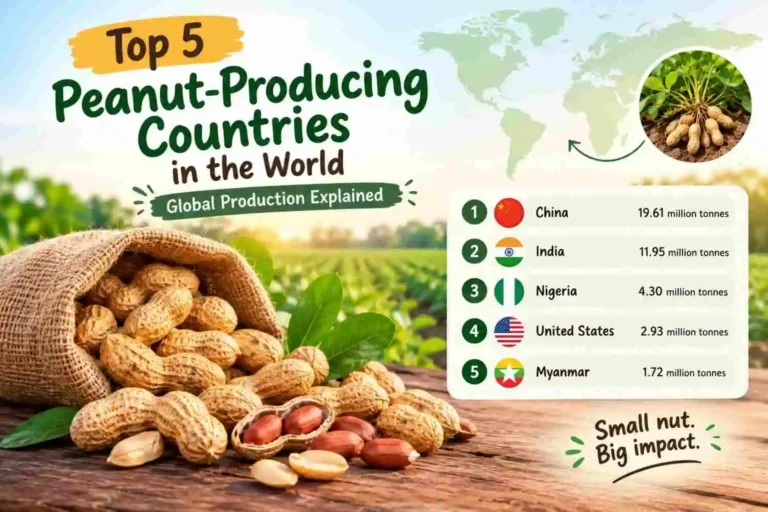
Peanut production is spread across Asia, Africa and the Americas, but a small group of countries accounts for a large share of global output. Based on 2024 FAOSTAT data, China, India, Nigeria, the United States and Myanmar were the five largest peanut-producing countries. Global groundnut production reached about 57.56 million tonnes in 2024.
In this blog, we look at the top 5 peanut producing countries, their production levels and why peanuts are important to their agricultural economies.
| Rank | Country | Peanut production in 2024 |
| 1 | China | 19.61 million tonnes |
| 2 | India | 11.95 million tonnes |
| 3 | Nigeria | 4.30 million tonnes |
| 4 | United States | 2.93 million tonnes |
| 5 | Myanmar | 1.72 million tonnes |
China is the world’s largest peanut-producing country.
In 2024, China produced approximately 19.61 million tonnes of groundnuts, accounting for about 34% of global production. Its large production comes from a combination of extensive cultivation, suitable growing conditions and established peanut farming systems.
Peanuts are used in China in several ways. They are eaten as snacks, used in cooking and processed into products such as peanut oil and other food ingredients.
China’s large domestic food market also creates considerable demand for peanuts. This makes peanut production important not only for farmers but also for food processing and related industries.
India is the second-largest peanut-producing country in the world.
India produced around 11.95 million tonnes of groundnuts in 2024, representing about 20.75% of global production.
Groundnuts are an important oilseed crop in India. They are grown in several agricultural regions and are used for direct consumption as well as processing.
Indian households use peanuts in many familiar foods, including roasted groundnuts, chutneys, snacks and sweets. Peanut oil is also used as a cooking oil in parts of the country.
India’s position as a major producer has remained important to the country’s edible-oil and food sectors. NITI Aayog, using FAOSTAT data, has also identified India as the world’s second-largest producer of groundnuts excluding shelled peanuts in its 2022–23 comparison.
Nigeria ranked third among the world’s largest peanut-producing countries in 2024.
Its production was approximately 4.30 million tonnes, or about 7.47% of global groundnut production.
Groundnuts are an important agricultural crop in Nigeria. They are grown mainly for food and processing, with uses including roasted peanuts, peanut-based foods and oil.
Peanut farming also provides an important source of income for agricultural communities. As with other major producing countries, production can vary depending on weather, rainfall, cultivated area and farming conditions.
The United States produced around 2.93 million tonnes of peanuts in 2024, placing it fourth among the world’s major peanut producers.
Peanuts are commercially grown in several states, particularly across the southern United States. The crop supplies a well-established food industry that produces peanut butter, roasted peanuts, confectionery and other peanut-based products.
The U.S. is also notable for its peanut productivity. Production depends not only on the amount of land planted but also on factors such as seed varieties, irrigation, farm machinery and crop management.
This makes the United States a useful example of how agricultural technology and farm productivity can influence total production.
Myanmar was the fifth-largest peanut-producing country in 2024, producing approximately 1.72 million tonnes of groundnuts.
Peanuts are an important crop in Myanmar and are used for both food and oil production.
The country’s warm growing conditions support peanut cultivation, while domestic consumption gives farmers a local market for their crops.
Myanmar’s place among the top five producers also shows that major peanut production is not limited to the largest economies. Agricultural conditions, available farmland and local farming practices all play a role.
There is no single reason why a country becomes a major peanut producer. Several factors work together.
Peanuts generally grow well in warm conditions. A suitable growing season, adequate moisture and appropriate soil conditions can help farmers produce good yields.
Countries with substantial areas available for crop cultivation can produce large quantities of peanuts. However, land area is only part of the picture because yield also matters.
Seed varieties, irrigation, pest management, machinery and other agricultural practices can affect how much peanuts farmers harvest from a given area.
Peanuts have many uses. They can be eaten directly, roasted, processed into peanut butter, pressed for oil or used as an ingredient in other foods.
When domestic demand is strong, peanut farming can become an important part of the agricultural and food-processing sectors.
Yes. Peanuts and groundnuts generally refer to the same crop.
“Peanut” is commonly used in everyday food and consumer language, while “groundnut” is widely used in agricultural and statistical contexts.
The plant has an unusual growth habit. After flowering, the developing pods grow underground, where the peanut seeds mature inside the shell.
This is also why production statistics often refer to “groundnuts in shell.”
China produces the most peanuts in the world.
According to 2024 data, China produced approximately 19.61 million tonnes, considerably more than India’s 11.95 million tonnes. Nigeria followed with 4.30 million tonnes.
Together, China and India accounted for more than half of global groundnut production in 2024.
Yes. Peanut production can change from one year to another.
Weather conditions, rainfall, drought, pests, disease, planted area and crop yields can all affect production. Changes in farming practices and agricultural technology can also influence output.
For this reason, a country’s position in the top peanut-producing countries can change over time.
It is therefore useful to mention the year when discussing global production figures. The FAOSTAT crop production dataset currently provides annual production, harvested-area and yield data through 2024.
Peanuts are grown in more than 100 countries, covering tropical, subtropical and some warm-temperate regions. In 2024, global groundnut production was approximately 57.56 million tonnes, with around 31.16 million hectares under production.
The five leading producers—China, India, Nigeria, the United States and Myanmar—together produced a large portion of the world’s peanuts.
Other countries also contribute significantly to global production, including several countries in Africa, Asia and the Americas. Their production levels can vary from year to year.
The Top 5 Peanut Producing Countries in the World show how important peanuts are to agriculture and food production across different regions. China and India are the two largest producers, followed by Nigeria, the United States and Myanmar.
In 2024, China produced about 19.61 million tonnes of peanuts, while India produced around 11.95 million tonnes. Nigeria, the United States and Myanmar completed the top five.
These peanut production rankings are a useful snapshot of global production, but they should always be considered alongside the specific year. Weather, farming conditions, harvested area and crop yields can cause production levels to change from one season to another.
For reliable comparisons of global peanut production, FAOSTAT provides country-level data on production, harvested area and yield. This makes it a useful reference when looking at how peanut production changes around the world.
All products are guaranteed to arrive in perfect condition at the specified shipping address provided. If you are not completely satisfied with the quality of your order upon arrival, please contact info@primenut.ae within 48 hours of order receipt, with a detailed description and photograph(s), for a replacement or exchange claim. Due to the perishable nature of our products, all requests submitted without proper supporting documents will not be eligible for re-shipment. Primenut reserves the right to limit replacements.
Primenut is not responsible for failed deliveries when:
An incorrect or outdated address is provided The recipient is not available An amended/new delivery address is not provided within 24 hours of the first delivery attempt Orders that are returned or diverted due to incorrect addresses, will be subject to additional charges based on the courier in the destination country.
All replacement requests must be made within 48 hours of order receipt, by contacting our customer care team at customercare@bateel.com Once the request has been received and approved, the replacement item(s) will be shipped within 2-5 working days. In case a replacement is not possible, a refund will be issued through the original payment method. Refunds can take from 10 to 30 working days to be reflected in your account. For a replacement or refund to be issued, at least one of the following conditions must apply:
The product has been damaged during delivery The product is defective or out of date The incorrect product was shipped
Primenut utilizes priority shipping to deliver your order within 2-5 working days. All orders are processed within 24 hours of order acceptance (Monday to Saturday, excluding holidays). You will receive a Shipment Confirmation email once your order has shipped containing your tracking number(s).
Primenut has a variable shipping fee depending on the delivery destination and size of the order. To find out exact shipping costs, please add your desired items into the cart and indicate delivery address to your basket. The final shipping fee will be calculated at the checkout.
Orders may be subject to import duties, VAT, taxes and customs clearance charges of the destination country. These additional charges, if any, are the sole responsibility of the customer. Primenut cannot be held accountable for charges incurred during the delivery of your order/package. Delivery delays may occur if your package is selected for inspection by your country’s Customs Department or Agency. In case of any exchange/cancellation queries, kindly go through our Returns & Refunds page. For multiple delivery enquiries, kindly send an email to info@primenut.ae