


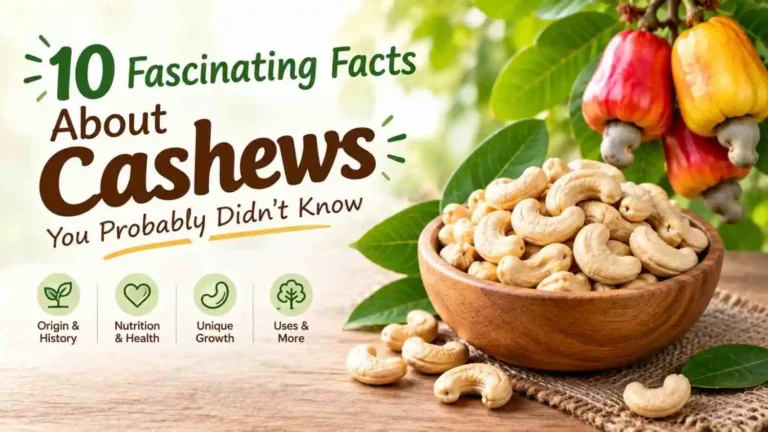
Cashews are familiar to most of us as a creamy, mildly sweet nut that works well in snacks, curries, desserts and trail mixes. But the cashew tree and the way its nut develops are quite unusual.
Unlike many common nuts, the cashew nut grows outside the fruit rather than inside it. The tree also produces a fleshy structure known as the cashew apple, which is used for food and beverages in some parts of the world.
Beyond their interesting growth pattern, cashews provide protein, unsaturated fats and several minerals. If you enjoy learning about the story behind everyday foods, here are Six Interesting Facts About Cashews You Probably Didn’t Know, along with useful information about their nutrition, processing and everyday use.
Cashews are native to tropical areas of South America, with northeastern Brazil generally recognized as their origin. The scientific name of the tree is Anacardium occidentale.
Cashews later spread to other tropical regions through trade and cultivation. Portuguese explorers played an important role in taking cashews to parts of Asia and Africa during the 16th century.
Today, cashew trees are grown in several tropical countries and the nut has become a familiar food around the world.
This is probably one of the most interesting cashew facts.
With many fruits, the seed develops inside the fruit. Cashews are different. The kidney-shaped cashew nut develops at the bottom of the fleshy cashew apple.
Botanically, the cashew apple is not the true fruit. It is a swollen part of the flower stalk, while the hard-shelled structure attached to it contains the actual fruit and seed. So, when you see a cashew growing on a tree, the familiar nut is hanging underneath the colorful cashew apple.
The nut gets most of the attention, but the cashew tree produces another useful food: the cashew apple.
Cashew apples can be yellow, orange or reddish when mature. They have a juicy, distinctive taste and are used in some regions to make juices, jams and other products.
The cashew apple is highly perishable, which makes it more difficult to transport and store than the dried nut. This is one reason the cashew kernel became much more widely traded internationally.
The cashew tree therefore provides more than one useful product. Modern research and agricultural work also recognize the value of the cashew apple and other parts of the crop.
A common misconception is that cashews can simply be picked, opened and eaten.
The raw cashew shell contains cashew nut shell liquid (CNSL), a naturally occurring substance that can irritate the skin. The shell therefore needs to be handled and removed through appropriate processing before the edible kernel is sold for consumption.
This is one reason commercial cashew processing requires specific equipment and controlled methods.
The cashew you buy in a supermarket has already gone through processing designed to safely separate the edible kernel from the shell.
The familiar curved or kidney-like shape of cashews is not created during processing.
The kernel naturally develops in that form inside the shell. After processing, the whole kernel can be graded according to its size, appearance and condition.
Cashews are commonly sold as whole kernels, pieces, splits or in processed forms such as roasted and flavoured nuts.
The shape also makes cashews easy to recognize among other commonly eaten tree nuts.
Cashews are more than a crunchy snack. They provide a combination of protein, fat, carbohydrates, fiber and minerals.
According to USDA-based food composition data, raw cashews contain substantial amounts of magnesium, phosphorus, copper, manganese and zinc. They also provide protein and unsaturated fats.
The exact nutrition of a serving depends on the product and preparation method.
For example, salted or flavored cashews can contain additional sodium, sugar or other ingredients. If nutrition is your main concern, checking the package label is a simple way to compare products.
Cashews can fit into a balanced diet because they provide a combination of nutrients rather than just one.
A serving provides plant protein and unsaturated fats, while minerals such as magnesium, copper, phosphorus, manganese and zinc contribute to their nutritional value.
However, cashews are also relatively energy-dense. That means portion size is worth considering, especially if you are eating them as a snack.
A small handful can be a practical serving. You can also combine cashews with fruit, yoghurt or other nuts and seeds for a more varied snack.
You don’t need complicated recipes to enjoy cashews.
Add chopped cashews to oatmeal or yoghurt in the morning. Sprinkle them over salads for extra crunch, or add them to rice and vegetable dishes.
They also work well in homemade trail mixes. If you prefer a simple snack, a small portion of roasted or plain cashews can be enough.
The goal is not to eat large quantities. Cashews are nutrient-rich, but they are also calorie-dense, so a sensible portion makes them easier to fit into an everyday eating pattern.
Cashews have a much more interesting story than their familiar appearance suggests. They originated in Brazil, grow in an unusual position outside the cashew apple, require careful shell processing and provide several useful nutrients.
Their mild flavor also makes them easy to use in both sweet and savory foods. Whether you enjoy them roasted as a snack or add them to everyday recipes, cashews can be a practical part of a varied and balanced diet.
The next time you eat a cashew, remember that this small curved kernel has a surprisingly unusual journey—from a tropical tree to a carefully processed food enjoyed around the world.
1. Where do cashews come from?
Cashews originated in tropical South America, especially Brazil, and later spread to other tropical regions through cultivation and trade.
2. Why can’t cashews be eaten directly from the shell?
Raw cashew shells contain cashew nut shell liquid, which can irritate the skin. That is why cashews need proper processing before the kernels are eaten.
3. What is a cashew apple?
A cashew apple is the fleshy part attached to the cashew nut. It is edible and is used in some countries to make juices, jams and other foods.
4. Are cashews nutritious?
Yes. Cashews provide protein, unsaturated fats, fibre and minerals such as copper, magnesium, phosphorus, manganese and zinc.
5. How can I eat cashews?
Cashews can be eaten on their own or added to salads, curries, rice dishes, yoghurt, trail mixes, desserts and many other recipes.
6. Are cashews actually nuts?
Cashews are commonly called nuts, but botanically, the edible part is the seed that grows attached to the cashew apple.
All products are guaranteed to arrive in perfect condition at the specified shipping address provided. If you are not completely satisfied with the quality of your order upon arrival, please contact info@primenut.ae within 48 hours of order receipt, with a detailed description and photograph(s), for a replacement or exchange claim. Due to the perishable nature of our products, all requests submitted without proper supporting documents will not be eligible for re-shipment. Primenut reserves the right to limit replacements.
Primenut is not responsible for failed deliveries when:
An incorrect or outdated address is provided The recipient is not available An amended/new delivery address is not provided within 24 hours of the first delivery attempt Orders that are returned or diverted due to incorrect addresses, will be subject to additional charges based on the courier in the destination country.
All replacement requests must be made within 48 hours of order receipt, by contacting our customer care team at customercare@bateel.com Once the request has been received and approved, the replacement item(s) will be shipped within 2-5 working days. In case a replacement is not possible, a refund will be issued through the original payment method. Refunds can take from 10 to 30 working days to be reflected in your account. For a replacement or refund to be issued, at least one of the following conditions must apply:
The product has been damaged during delivery The product is defective or out of date The incorrect product was shipped
Primenut utilizes priority shipping to deliver your order within 2-5 working days. All orders are processed within 24 hours of order acceptance (Monday to Saturday, excluding holidays). You will receive a Shipment Confirmation email once your order has shipped containing your tracking number(s).
Primenut has a variable shipping fee depending on the delivery destination and size of the order. To find out exact shipping costs, please add your desired items into the cart and indicate delivery address to your basket. The final shipping fee will be calculated at the checkout.
Orders may be subject to import duties, VAT, taxes and customs clearance charges of the destination country. These additional charges, if any, are the sole responsibility of the customer. Primenut cannot be held accountable for charges incurred during the delivery of your order/package. Delivery delays may occur if your package is selected for inspection by your country’s Customs Department or Agency. In case of any exchange/cancellation queries, kindly go through our Returns & Refunds page. For multiple delivery enquiries, kindly send an email to info@primenut.ae