


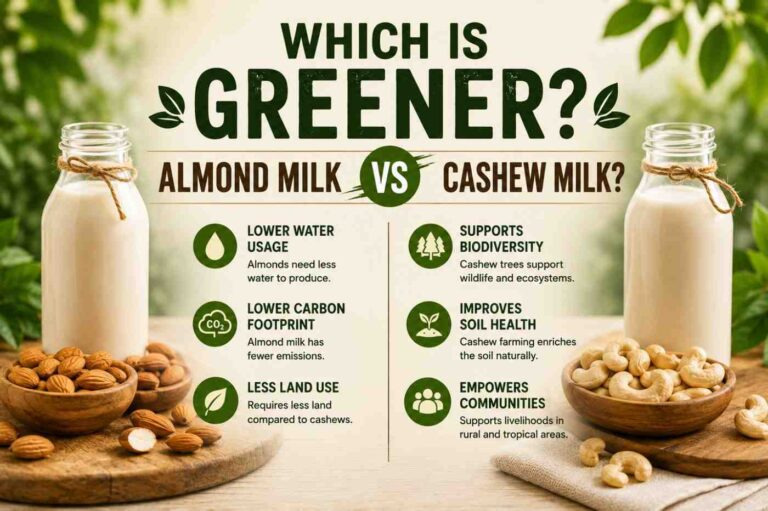
Almond Milk and Cashew Milk are both plant-based alternatives to dairy, but their environmental impact is not quite the same. Water use is one of the main concerns with almond milk, especially in California, where almond farming relies heavily on irrigation. One life-cycle study found that almond cultivation made up about 95% of the freshwater use linked to the almond milk studied.
Cashew Milk has its own environmental concerns, including farming, land use, processing and transport. However, there is much less research directly comparing commercial cashew milk with almond milk. Because of that, it would be too strong to say that cashew milk is always the greener choice.
Water is usually the first issue that comes up when discussing almond milk and sustainability. Almond trees need water during the growing season, and much of the commercial almond crop in California is grown with irrigation. One life-cycle assessment of unsweetened almond milk made with California almonds estimated freshwater consumption at 175 kg for a 48-ounce (1.42-litre) bottle, with about 167 kg linked to almond cultivation.
That figure should not be applied to every almond milk product. Farming conditions, irrigation practices, crop yields and location can change water use. The same amount of water can also have a very different environmental impact depending on whether it is used in a water-stressed area or somewhere with more available water. So, the simple claim that almond milk “uses too much water” does not tell the whole story.
Cashew Milk is made using cashews and water, although the ingredients and manufacturing process can vary between products. Compared with almond milk, there is less widely available life-cycle research specifically looking at commercial cashew milk. This makes a direct environmental comparison harder.
Cashews are grown mainly in tropical and subtropical areas, including parts of Africa and Asia. Their farming systems are different from the irrigated almond orchards commonly associated with California. Still, cashew production can involve land use, farming inputs, processing and transportation, so growing conditions and sourcing matter.
If freshwater use is your main concern, almond milk has a clear drawback. The California almond milk study found that irrigation for almond cultivation was the biggest contributor to freshwater consumption in the supply chain it assessed.
Where that water is used also matters. Irrigation in a region already dealing with drought or water pressure can have greater environmental consequences than the same amount of water used in a region with fewer shortages. This is why the growing location of almonds is worth considering rather than looking only at the name of the ingredient.
It might be tempting to say that cashew milk is greener simply because almond farming can require substantial irrigation. There is not enough evidence to make that claim confidently. Cashew farming also has environmental questions involving land use, agricultural practices, crop yields and processing.
There is another problem when comparing studies: they may not measure the same parts of the supply chain. One study might focus on farming, while another includes processing, packaging and transport. Because the methods and boundaries can differ, comparing individual figures can give a misleading impression.
Water is only one part of the environmental picture. Greenhouse gas emissions, energy use, packaging, land use and transportation can also affect the footprint of plant-based milk.
The California almond milk life-cycle assessment estimated 0.71 kg of CO₂-equivalent emissions for a 48-ounce bottle. Packaging was a meaningful part of the carbon footprint in that study. This shows that what happens after the almonds are grown can matter too. The container still needs to be produced, filled, transported and eventually recycled or discarded.
Two cartons of almond milk or cashew milk may not have exactly the same environmental footprint. Almonds grown under different irrigation conditions can require different amounts of water, while cashews grown in different regions can have different yields and farming inputs.
Transport is another part of the picture, particularly for cashews that may move from growing regions to processing facilities and then to consumer markets. Still, transportation should not be considered on its own. Where and how the nuts are grown can be just as important as which nut is used.
Both almond and cashew milk go through processing before they reach the shelf. Manufacturers may also use ingredients such as stabilisers, oils, sweeteners, salt or added nutrients. Different recipes and production methods can therefore lead to different environmental footprints.
Packaging also plays a role. The almond milk study found that packaging contributed to greenhouse gas emissions and energy use. For consumers, choosing practical packaging, checking whether it can be recycled locally and avoiding products that are likely to be wasted are useful steps regardless of the type of plant milk.
There is no simple overall winner. Almond milk has a well-documented concern around freshwater use, particularly when almonds are grown in heavily irrigated or water-stressed areas. The California study shows how strongly almond cultivation can influence the freshwater footprint.
Cashew Milk may avoid some of that particular irrigation concern, but that does not make it automatically greener. Cashew farming, processing, land use and transportation also matter, while direct life-cycle comparisons between commercial almond and cashew milk remain limited.
You do not need to study environmental assessments every time you buy plant-based milk. If sourcing information is available, check where the main ingredient comes from and consider the type of packaging used.
It also makes sense to buy an amount you are likely to finish. Wasting food or throwing away unused products adds to the environmental impact. The more useful approach is to look at the product as a whole rather than judging it only by whether it contains almonds or cashews.
So, which is greener: almond milk or cashew milk? Almond milk has the clearer concern when it comes to freshwater use, especially for almonds grown in irrigated areas such as California.
Cashew milk can be a reasonable alternative, but there is not enough comparable evidence to call it the overall environmental winner. Farming location, land use, processing, packaging and transportation all have a part to play. Looking at the whole supply chain gives a more realistic answer than simply choosing one nut over the other.
1. Which is greener, almond milk or cashew milk?
Cashew milk may have an advantage in some areas, but there is not enough comparable research to say it is always greener than almond milk.
2. Does almond milk use a lot of water?
Yes. Almond production can require substantial irrigation, particularly in water-stressed regions such as California.
3. Is cashew milk better for the environment than almond milk?
Not necessarily. Cashew farming also has environmental impacts related to land use, farming, processing and transportation.
4. Why is almond milk associated with high water use?
Almond trees need water during production, and much of the commercial almond crop in California depends on irrigation.
5. Does where almonds are grown affect their environmental impact?
Yes. Growing conditions, irrigation practices and local water availability can change the environmental impact of almond production.
6. Does cashew farming affect the environment?
Yes. Land use, farming practices, processing and transportation can all affect the environmental footprint of cashews.
7. Is water use the only factor when comparing almond and cashew milk?
No. Greenhouse gas emissions, land use, energy, packaging and transportation also matter.
8. Does packaging affect the environmental impact of plant milk?
Yes. Producing, transporting and disposing of the bottle or carton can contribute to the product’s overall environmental footprint.
9. Which should I choose if water conservation is my main concern?
Cashew milk may be worth considering, but the better choice depends on where and how the ingredients are produced.
10. Is cashew milk always more sustainable than almond milk?
No. There is not enough direct research to support that conclusion in every situation.
All products are guaranteed to arrive in perfect condition at the specified shipping address provided. If you are not completely satisfied with the quality of your order upon arrival, please contact info@primenut.ae within 48 hours of order receipt, with a detailed description and photograph(s), for a replacement or exchange claim. Due to the perishable nature of our products, all requests submitted without proper supporting documents will not be eligible for re-shipment. Primenut reserves the right to limit replacements.
Primenut is not responsible for failed deliveries when:
An incorrect or outdated address is provided The recipient is not available An amended/new delivery address is not provided within 24 hours of the first delivery attempt Orders that are returned or diverted due to incorrect addresses, will be subject to additional charges based on the courier in the destination country.
All replacement requests must be made within 48 hours of order receipt, by contacting our customer care team at customercare@bateel.com Once the request has been received and approved, the replacement item(s) will be shipped within 2-5 working days. In case a replacement is not possible, a refund will be issued through the original payment method. Refunds can take from 10 to 30 working days to be reflected in your account. For a replacement or refund to be issued, at least one of the following conditions must apply:
The product has been damaged during delivery The product is defective or out of date The incorrect product was shipped
Primenut utilizes priority shipping to deliver your order within 2-5 working days. All orders are processed within 24 hours of order acceptance (Monday to Saturday, excluding holidays). You will receive a Shipment Confirmation email once your order has shipped containing your tracking number(s).
Primenut has a variable shipping fee depending on the delivery destination and size of the order. To find out exact shipping costs, please add your desired items into the cart and indicate delivery address to your basket. The final shipping fee will be calculated at the checkout.
Orders may be subject to import duties, VAT, taxes and customs clearance charges of the destination country. These additional charges, if any, are the sole responsibility of the customer. Primenut cannot be held accountable for charges incurred during the delivery of your order/package. Delivery delays may occur if your package is selected for inspection by your country’s Customs Department or Agency. In case of any exchange/cancellation queries, kindly go through our Returns & Refunds page. For multiple delivery enquiries, kindly send an email to info@primenut.ae