


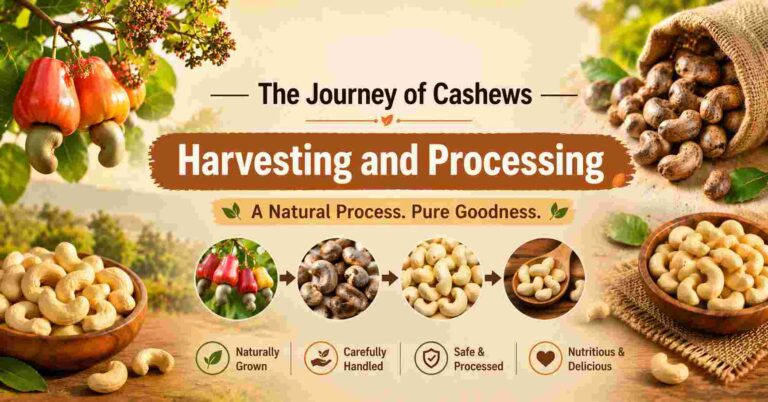
Cashews are easy to eat and often part of daily snacks, but getting them to your plate is not. Most people don’t think beyond the packet, yet the process behind cashews takes time, care, and a bit of skill at every stage.
The Journey of Cashews: Harvesting and Processing explained begins with something many people don’t expect. Unlike other nuts, cashews grow in a way that surprises many people the first time they see it. They don’t sit inside a hard shell on a branch like almonds or walnuts. Instead, they hang outside a fruit, which changes how they are handled right from the start, requiring careful processing to separate them from the cashew apple and ensure they are safe for consumption.
Cashews don’t go straight from the farm to your snack bowl. They go through a number of steps, and each one helps keep them safe and fresh. If something isn’t handled properly, the quality can drop. That’s why cashews need a bit more care than other nuts, especially since their shells have to be removed and they’re carefully processed before eating.
Cashew trees are mostly found in warm regions such as India, Vietnam, Brazil, and parts of Africa. They don’t need much care, but they do need the right tropical climate to grow properly.
What’s interesting is how they grow. The nut hangs outside, attached to the bottom of a cashew apple. The apple is soft and juicy, while the nut sits inside a hard shell. Because of this, both parts are handled separately during harvesting, which makes the process a bit more careful than other nuts.
Cashew harvesting is not rushed. Farmers usually wait until the fruit is fully ripe. At that stage, the cashew apple falls to the ground on its own. Instead of plucking it from the tree, workers collect the fallen fruits.
On big farms, this process takes a long time, even though it sounds easy. Handling the nuts roughly at this stage can cause damage, as they remain delicate.
After the nuts are separated from the fruit, they aren’t processed right away. They’re usually spread out in the sun to dry. It removes the water and makes them easier to store or handle later.
Farmers leave them out for a few days and turn them now and then so they dry evenly. It takes time, but it’s important; if this step is rushed, the nuts may not keep well or taste as good.
Cashews can’t be eaten straight after picking. The outer shell has a natural substance that can irritate the skin, so it needs to be removed carefully.
Because of these factors, the whole process is done step by step to safely take off the shell without damaging the nut inside.
Before the shell is opened, the nuts are either roasted or steamed. This step makes the shell easier to break and also helps deal with the natural oil inside it.
The heating is controlled. Too much heat can affect the nut, while too little won’t prepare it properly.
Once the nuts are treated, the shell is cracked open. In many places, this is still done by hand or with simple tools.
This step needs attention. The kernel inside is soft and can break easily, so workers take care while removing it.
After shelling, the kernels are dried once more. This helps in removing the thin outer skin that sticks to the nut. It also improves how long they can be stored.
The thin skin covering the cashew is removed at this stage. Once peeled, the nut takes on the smooth look people are familiar with.
This part is usually done carefully to avoid damaging the shape of the cashew.
Cashews are then sorted based on size and appearance. Whole cashews are separated from broken ones.
Grading helps maintain consistency when the nuts reach the market.
Most people don’t think about each nutrient separately. They simply include cashews as part of their regular food, which is enough in most cases.
Cashews might seem like a simple snack, but there’s a lot that happens before they reach your plate. From growing in warm regions to being dried and processed, every step plays its part.
Once you understand how they are handled, you start to see them differently. They’re not just picked and eaten; they go through careful steps like cleaning, sorting, and processing to ensure that they’re safe and ready to enjoy.
1. How are cashews harvested?
Cashews are collected after the fruit falls, and the nut is separated and dried.
2. Why can’t cashews be eaten directly after harvesting?
Because the outer shell isn’t safe, it must be removed properly before eating.
3. What is the first step in processing cashews?
The nuts are heated first to make the shell easier to remove.
4. Where are cashews mainly grown?
They grow in warm regions like India, Vietnam, Brazil, and parts of Africa.
5. What happens after cashews are processed?
They are sorted, checked, and packed to keep them fresh.
All products are guaranteed to arrive in perfect condition at the specified shipping address provided. If you are not completely satisfied with the quality of your order upon arrival, please contact info@primenut.ae within 48 hours of order receipt, with a detailed description and photograph(s), for a replacement or exchange claim. Due to the perishable nature of our products, all requests submitted without proper supporting documents will not be eligible for re-shipment. Primenut reserves the right to limit replacements.
Primenut is not responsible for failed deliveries when:
An incorrect or outdated address is provided The recipient is not available An amended/new delivery address is not provided within 24 hours of the first delivery attempt Orders that are returned or diverted due to incorrect addresses, will be subject to additional charges based on the courier in the destination country.
All replacement requests must be made within 48 hours of order receipt, by contacting our customer care team at customercare@bateel.com Once the request has been received and approved, the replacement item(s) will be shipped within 2-5 working days. In case a replacement is not possible, a refund will be issued through the original payment method. Refunds can take from 10 to 30 working days to be reflected in your account. For a replacement or refund to be issued, at least one of the following conditions must apply:
The product has been damaged during delivery The product is defective or out of date The incorrect product was shipped
Primenut utilizes priority shipping to deliver your order within 2-5 working days. All orders are processed within 24 hours of order acceptance (Monday to Saturday, excluding holidays). You will receive a Shipment Confirmation email once your order has shipped containing your tracking number(s).
Primenut has a variable shipping fee depending on the delivery destination and size of the order. To find out exact shipping costs, please add your desired items into the cart and indicate delivery address to your basket. The final shipping fee will be calculated at the checkout.
Orders may be subject to import duties, VAT, taxes and customs clearance charges of the destination country. These additional charges, if any, are the sole responsibility of the customer. Primenut cannot be held accountable for charges incurred during the delivery of your order/package. Delivery delays may occur if your package is selected for inspection by your country’s Customs Department or Agency. In case of any exchange/cancellation queries, kindly go through our Returns & Refunds page. For multiple delivery enquiries, kindly send an email to info@primenut.ae